Baked Into the Business: Papa Murphy's Largest Operator Prepares for the Future

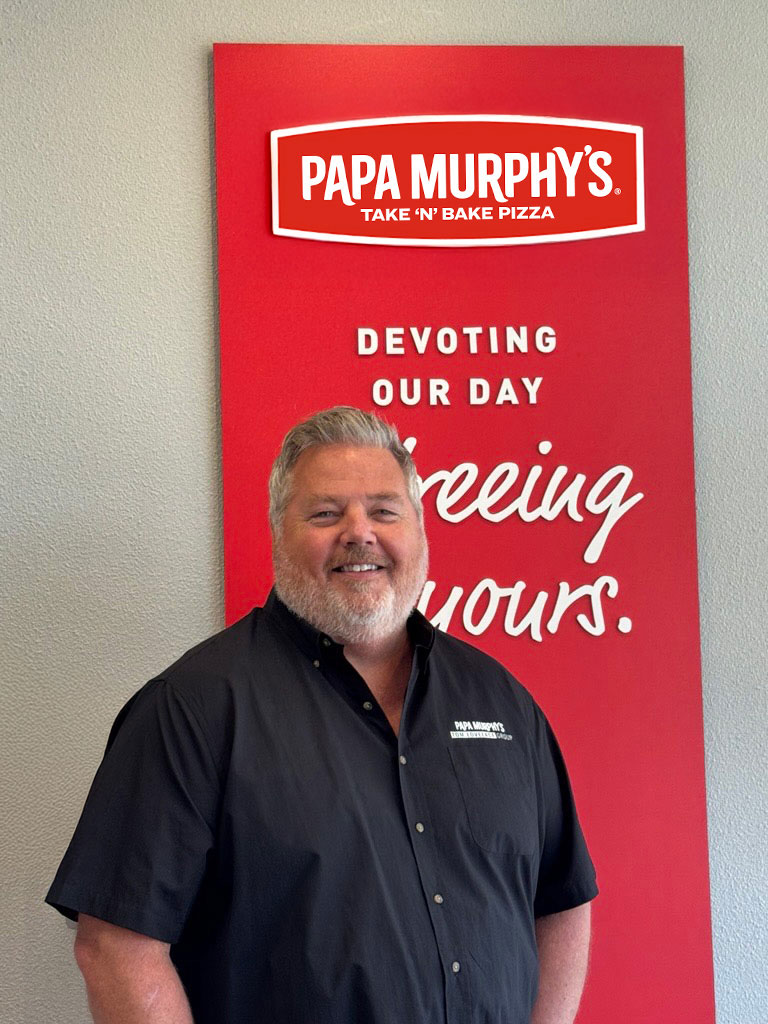
Name: Tom Lovelace
Title: Owner/President
Company: Tom Lovelace Group
No. of units by brand: 96 Papa Murphy’s
Age: 63
Family: Wife Lisa, children, Jeremy, 42, and Jenn, 40, and six grandchildren
Years in franchising: 35
Years in current position: 35
Tom Lovelace’s nearly 50-year career in the restaurant industry will likely conclude within the next year. Before he turns over the reins of his 96 Papa Murphy’s units to his children, however, he has some things left to accomplish. Ever the restaurant lifer, Lovelace wants to optimize profitability and communication across each of his stores to ensure his business is in good hands for the next generation of his family.
Lovelace got his start in the industry as a busboy when he was 14 and worked in several restaurants as a teenager before heading to the University of Oregon on a football scholarship. After one year on campus, he decided he needed to take another direction in life by getting married and starting his career. At age 19, he married his girlfriend Lisa and enrolled in the McDonald’s management program. “Forty-four years later, those proved to be the right decisions,” he says.
After spending 11 years as a manager in the McDonald’s system and learning all aspects of restaurant operations, Lovelace decided it was time to become an owner. He was attracted to Papa Aldo’s (later Papa Murphy’s), a burgeoning take-and-bake pizza franchise based in his native Pacific Northwest. Although he considered becoming a McDonald’s franchisee, Lovelace preferred Papa Aldo’s operational advantages of fewer hours and employees and a smaller store footprint than the burger chain. He and his brother Jim, who also worked at McDonald’s, purchased two stores from a local owner, but the acquisition came with stress.
“I was scared to death,” Lovelace says. “I went from having a secure paycheck every two weeks to mortgaging our house and putting everything on the line for something we believed we could do. Coming from McDonald’s, it was all about systems. So, it was the same experience for us, and it was an easy transition.”
For the first decade of his ownership, Lovelace only operated in Washington state. As the brand grew, he became its first franchisee in Canada in 2006 and operated 16 stores over three years north of the border. Today, he is the largest franchisee in the Papa Murphy’s system with 96 locations across 12 states.
Lovelace credits the franchise model with his ability to scale the business. He said having effective systems in place, including training programs and supply chain management, helped the most during his early years. He now relies upon strong marketing programs and assistance with real estate for new restaurants.
Over the next year, Lovelace will turn over ownership of the company to his two children, who have worked for him for two decades and have been brought along with a succession plan for the past five to six years. His son Jeremy is VP of operations, and his daughter Jenn is an accountant, and both will continue in similar roles after the transition. Although he will oversee legal matters in a chairman role, Lovelace looks forward to traveling more with his wife in the coming years, knowing the company is in good hands with his children at the helm.
PERSONAL
First job: As a busboy at a restaurant in Vancouver, Washington, when I was 14.
Formative influences/events: Growing up, we didn’t have much, but I excelled in football. I saw my hard work pay off when I was awarded a scholarship to play Division 1 football. That mentality that you need to work hard to achieve your goals has stuck with me throughout my career.
Key accomplishments: In a joint venture with Papa Murphy’s International, we opened the first 16 stores in Canada. Our group was also the first Papa Murphy’s to operate branded locations within a professional sports stadium. For three years, we were the exclusive pizza provider for every event at Quest Field (now Lumin Field) in Seattle. At its peak, we grew our portfolio to 107 stores.
Biggest current challenge: There are a few. The quality and cost of labor in our restaurants. Another is the increasing costs of goods and real estate. All expenses continue to go up.
Next big goal: Completing my exit strategy by handing the business over to the kids.
First turning point in your career: Buying my first two Papa Murphy’s locations. Once we purchased the first two, it wasn’t long before we acquired our third and fourth, and we have grown exponentially since then.
Best business decision: To invest in great people and pour into them. I knew that if we were going to successfully expand, we needed to have good people to do it. We emphasized hiring the right people and developing them, so we had a strong bench of people in place for when we expanded.
Hardest lesson learned: You can’t grow properly without having your infrastructure in place first. When we first expanded out of Washington state and into California, we tried to do it on the cheap. We purchased three stores and ran them through Washington. It didn’t work, and it was a
painful experience.
Work week: Six to seven days a week. I usually spend Monday through Friday in the office or traveling. I use the weekends to catch up or prepare for the upcoming week.
Exercise/workout: Not as much as I should, but I do get out and golf every now and then.
Best advice you ever got: Work really hard and then work harder to achieve your goals. It came from a coach during my football-playing days. Being big isn’t good enough. You have to work harder than the person across the line from you.
What’s your passion in business? I love to grow. I’ve had the privilege to help grow the overall Papa Murphy’s brand, along with my own organization, for the past 35 years. We went from around 70 stores to more than 1,500 at its peak.
How do you balance life and work? Being a family business, those lines have always been pretty blurred, but we’ve made it work. Business issues constantly come up during family time, but we only discuss them if we need to. We try to protect family time by discussing business later.
Guilty pleasure: Pizza.
Favorite book: Good to Great by Jim Collins.
Favorite movie: Anything with Will Ferrell in it.
What do most people not know about you? I received a scholarship to play Division 1 football at Oregon, but after the first season, I actually gave my scholarship back, left school, and married my wife. I started my career rather than going back to college and began working with a franchisee of multiple McDonald’s. I worked my way up through the ranks and ended up running multiple stores for them.
Pet peeve: People who won’t do what is needed to achieve their goals.
What did you want to be when you grew up? A professional football player.
Last vacation: Fort Lauderdale, Florida, in April.
Person you’d most like to have lunch with: President Donald Trump.
MANAGEMENT
Business philosophy: We believe that people come first, and every decision we make is guided by care, respect, and commitment to improving lives.
Management method or style: Put the right people in leadership positions and provide the necessary support and resources to succeed.
Greatest challenge: Staffing our stores with great people. Before Covid, we could be selective in our hiring process, and many employees were high school and college age. Now, the quality of the hiring pool is different. People have less of a connection to the brand. It is now more difficult to identify people and develop them.
How do others describe you? A man of faith who is hardworking, loyal, and, hopefully, kind and caring.
Have you ever been in a mentor-mentee relationship? What did you learn? When I first started in the QSR space with McDonald’s, I learned a lot from the local owner on how to run multiple locations. That’s stuck with me throughout my career. I’ve also had the privilege to mentor many young men and women over the years and learned that everyone responds differently to pressure and accountability. Some thrive in that environment while others shrivel away.
One thing you’re looking to do better: Communication, both personally and within our organization. It can be a challenge with an organization of our size. I’ve tried to work on it over the years, and it will be a priority for me for the rest of my time in the business. I don’t need many people around me, and I can work alone, which can be a detriment. I need to work on getting the buy-in from all our employees and motivating them effectively.
How you give your team room to innovate and experiment: We provide them with the opportunity to make their own decisions on a day-to-day basis (within reason). For example, if they think we need to focus more on digital or local store marketing over print, we empower them to make those decisions and own the initiative.
How close are you to operations? Not as close as I used to be. My son Jeremy is the VP of operations and has run operations for years, and he does a great job. However, I love being in our stores with our crews and customers. I would do that every day if I could.
What are the two most important things you rely on from your franchisor? Effective marketing that grabs people’s attention and attracts them into our stores. We also expect the flawless execution of initiatives.
What you need from vendors: Great pricing, excellent service, and on-time deliveries.
Have you changed your marketing strategy in response to the economy? How? It seems like everyone is trying to play in the value space right now. We have always been there, so it is getting crowded, but it’s one of the many things that makes Papa Murphy’s great and keeps customers coming through the door.
How is social media affecting your business? Positively for the most part. But trying to stay relevant and current can be challenging. The key is to be genuine and prompt in how we respond to comments from our guests.
In what ways are you using technology (like AI) to manage your business? We continue to test ways to be more efficient and provide a better guest experience with AI, such as phone answering and projection models.
How do you hire and fire? We try to adhere to the saying “slow to hire, quick to fire.” However, during Covid, we really struggled to keep great employees in the stores. Now, it’s becoming a bit easier to build out a great bench of people who are motivated to become leaders.
How do you train and retain? With our management style, we try to ensure that those who are training and retraining believe in our process and see the benefits of a fully trained employee.
How do you deal with problem employees? Head on. We encourage our leaders to invest in and coach all our staff until they feel there is no return on investment.
Fastest way into your doghouse: Dishonesty and laziness.
BOTTOM LINE
Annual revenue: $60 million.
Goals over the next year: I would like to fine-tune our operations by improving the customer service and profitability in all our stores. If a store is not performing properly, we need to figure out if it is the right location for us.
Growth meter: How do you measure your growth? I look at growth in more than just numbers. To me, real growth is when people become more confident, step into new challenges, and work better together. It shows up when the team communicates more openly and supports each other. It’s when guests can feel the difference in their
experience with us. The numbers matter, but the biggest sign of growth is seeing our people thrive.
Vision meter: Where do you want to be in five years? 10 years? I love what I do, but I know my kids are more than ready to take over the business. The business will be in good hands, so my wife and I look forward to more travel.
Do you have brands in different segments? Why/why not? We do not. We decided early on that we would stay focused on one thing and do it well.
How is the economy in your region(s) affecting you, your employees, your customers? The economy is affecting everyone nationwide, and our locations are in various markets, but we’re leaning into the fact that Papa Murphy’s offers value deals to help offset these impacts.
Are you experiencing economic growth in your market? We have stores all across the country, so it does vary market to market. We’ve seen growth in Tucson, Arizona, for a while and the entire state of Texas with so many people moving there.
How do changes in the economy affect the way you do business? We have to trust our leaders in each market to advise us of what is happening locally so that we can react quickly. Based on that information, we can decide to be more aggressive with our promotions or be more involved with local store marketing.
How do you forecast for your business? We look at the trailing 12 months and factor in market-specific data to forecast future sales.
What are the best sources for capital expansion? Early on, we made the decision that we would try to expand our portfolio through existing cash flow and have very little debt, which we’ve been able to accomplish.
Experience with private equity, local banks, national banks, other institutions? Why/why not? Local banks, but other than when we first started and one-time specific needs, we haven’t used them very often.
What are you doing to take care of your employees? We’re showing them daily that we’re invested in their growth and providing leadership pathways to those who excel in their roles.
We try to make everyone feel valued and be consistent with that. It is so expensive to onboard someone. Turnover costs money, so retention is a priority. We have awards for longevity, which is uncommon in this industry.
How are you handling rising employee costs (payroll, minimum wage, healthcare, etc.)? We try to control our expenses as best we can, but as costs go up, we are forced to consider all options. We have stores in multiple states, so it varies depending on where we’re doing business. All we can do is manage our controllables.
What laws and regulations are affecting your business, and how are you dealing with them? Since we operate in multiple states, we have to comply with a wide range of mandates, some of which are more business friendly than others. Our team works hard to stay ahead of new legislation to ensure that we are always in compliance. It’s a complex but necessary part of doing business at this scale. The most challenging regulations are in Washington, Oregon, and California, and they involve scheduling and minimum wage.
How do you reward/recognize top-performing employees? Outside of the previously mentioned incentives, we pride ourselves on promoting from within. These promotions come from our top performers and have allowed us to grow over
the years.
What kind of exit strategy do you have in place? I anticipate exiting within the next year. We started planning my exit five to six years ago. My kids have been involved in the business for more than half their lives, and from the beginning, the plan has been to have them carry on the legacy.
Share this Feature


Recommended Reading:


Franchising.com is produced by Franchise Update Media. Franchise Update Media has its finger on the pulse of franchising with unrivalled audience intelligence and market driven data. No media company understands the franchise landscape deeper than Franchise Update Media.
1201 New York Avenue NW, Suite 300A
Washington, DC 20005
PH. (408) 402-5681
 The multi-unit franchise opportunities listed above are not related to or endorsed by Multi-Unit Franchisee or Franchise Update Media Group. We are not engaged in, supporting, or endorsing any specific franchise, business opportunity, company or individual. No statement in this site is to be construed as a recommendation. We encourage prospective franchise buyers to perform extensive due diligence when considering a franchise opportunity.
Copyright © 2001 - 2026. All Rights Reserved. Legal Notices | Privacy Policy


