Deliver on Experience: Commit to Developing Your Team's Soft Skills

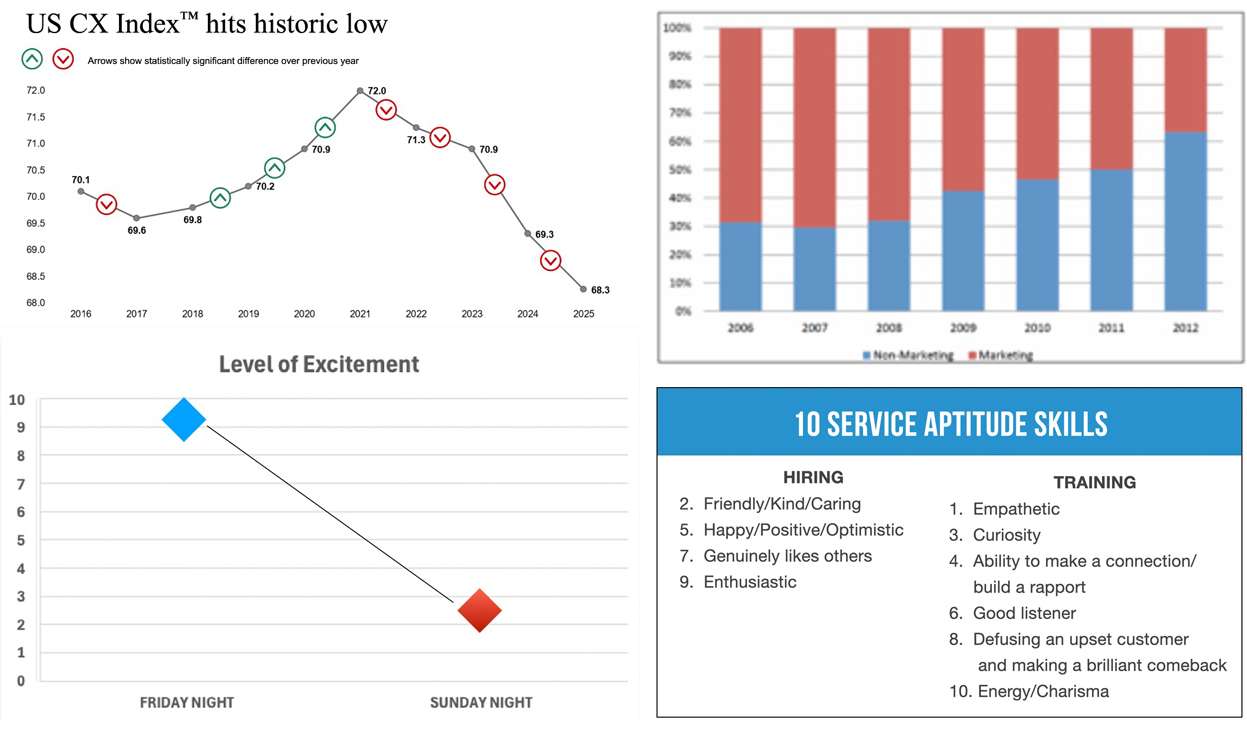
A recent study found that 66% of consumers are ready to walk if a brand breaks a promise. When the customer experience (CX) bar is low, brands can stand out and make the experience they deliver their most significant competitive advantage. According to a Wall Street Journal report, 86% of 800 C-suite members surveyed expect CX to become a top-tier investment priority.
A key reason why CX quality among brands has plummeted is the lack of soft skills among customer-facing employees. We live in the digital disruption era. Technology has brought unprecedented advances in information, knowledge, instant access, and entertainment. As convenient as these advances are, they have changed how we communicate, behave, and think, dramatically declining our people skills.
While these skills seem like basic expectations of individuals in the workforce, one study showed that nearly 60% of leaders in the U.S. believe it’s challenging to find candidates with soft skills. In the age of AI, it is still the responsibility of companies to continually develop these skills in their employees.
Microlearning
The days of having employees watch hours of talking heads or training videos are gone, and nobody’s reading training manuals. The way employees learn, retain, and consume information has undergone significant evolution.
Microlearning is an educational approach that delivers content in short, focused segments, typically lasting less than five minutes (think TikTok, YouTube Shorts, or Instagram Reels). These concise learning units are easily digestible and accessible at the learner’s convenience.
The Big KPIs
Businesses that only measure Net Promoter Score or customer satisfaction survey results are falling significantly behind. Today, customers have survey fatigue. Customer surveys are a dinosaur and broken. As I write this, I have six surveys sitting in my email inbox and three others in my text messages. Brands are asking for my feedback, but I won’t be responding. Today, survey response rates have never been lower.
The two most undervalued KPIs business leaders can track, obsess over, and build awareness around are customer retention and customer referrals. The best measure of a brand’s customer experience is Earned Sales Growth (ESG), which measures the revenue growth generated by returning loyal customers and their referrals. Your revenue comes from bought sales (advertising) and earned sales (repeat and referrals).
Imagine a law firm’s earned sales growth over the past seven years. In the first few years, it has an ESG of 30%, meaning that 70% of its new clients came from advertising (bought sales). Believe it or not, that's an excellent ESG for injury attorneys. However, as the firm trained its people in CX soft skills, its ESG grew to nearly 65%. This is a massive decrease in advertising dollars as customers return and refer friends and family based on the care they received.
Ready for Monday
I love the following question to measure employee morale:
- On a scale of 1–10, how do you feel on Friday at 6 p.m.?
- On a scale of 1–10, how do you feel on Sunday at 6 p.m.?
The most common answer I get from Monday-Friday workers is an 8 or higher on Friday night. It’s lower than 3 on a Sunday night. I know people who have told me they start to get a knot in their stomach around Sunday night, and they dread Monday mornings.
What if your employees averaged 6, 7, or 8 on Sunday night? Your morale would be incredibly high, and your turnover would be extremely low. Every leader’s goal should be to build a culture where people are excited about the work they do.
As leaders, we need to build companies that help employees be proud of the work they do. We want them living their best lives. That requires training your people.
Top Concerns
Too often, employee training happens in their first few years. According to LinkedIn’s Workforce Learning Report, 94% of employees say that they would stay at a company longer if it simply invested in helping them learn.
This interest in learning and development is strong among younger workers. LinkedIn’s research found that roughly a quarter of Gen Zers and Millennials say learning is the number one thing that makes them happy at work. More than a quarter (27%) of Gen Zers and Millennials say the number one reason they’d leave their job is that they didn’t have the opportunity to learn and grow.
Human Touch
The AI revolution is reshaping how organizations approach customer experience. Leaders are rushing to automate more, cut labor costs, and reduce customer-facing roles. In doing so, they risk losing the human touch that drives customer loyalty. Most current AI tools focus on efficiency while overlooking the emotional connection that customers crave. AI excels at making business easier, but humans still create the experiences customers remember.
AI is not intended to replace human agents. By combining AI with human expertise, businesses create meaningful engagement and foster loyalty. In this changing environment, brands must invest in technology. There’s no other option. And if leaders want to deliver a standout customer experience, they need to commit to teaching the soft skills that elevate human expertise.
John DiJulius III, author of The Customer Service Revolution, is president of The DiJulius Group, a customer service consulting firm that works with companies such as Starbucks, Chick-fil-A, Ritz-Carlton, Nestle, PwC, Lexus, and many more. Contact him at [email protected] or 216-839-1430.
Share this Feature


Recommended Reading:


Franchising.com is produced by Franchise Update Media. Franchise Update Media has its finger on the pulse of franchising with unrivalled audience intelligence and market driven data. No media company understands the franchise landscape deeper than Franchise Update Media.
1201 New York Avenue NW, Suite 300A
Washington, DC 20005
PH. (408) 402-5681
 The franchise opportunities listed above are not related to or endorsed by Franchising.com or Franchise Update Media Group. We are not engaged in, supporting, or endorsing any specific franchise, business opportunity, company or individual. No statement in this site is to be construed as a recommendation. We encourage prospective franchise buyers to perform extensive due diligence when considering a franchise opportunity.
Copyright © 2001 - 2026. All Rights Reserved. Legal Notices | Privacy Policy


