Growing With Grit: Former Marine Scales Through Discipline and Acquisitions

Name: Cheston Syma
Title: Multi-Unit Franchisee/Team Leader
Company: Wheelhouse Partners
No. of units: 43 Sport Clips, 2 Big Blue Swim School, 2 SweatHouz, and 1 Hand & Stone Massage and Facial Spa
Age: 49
Years in franchising: 22
Years in current position: 22
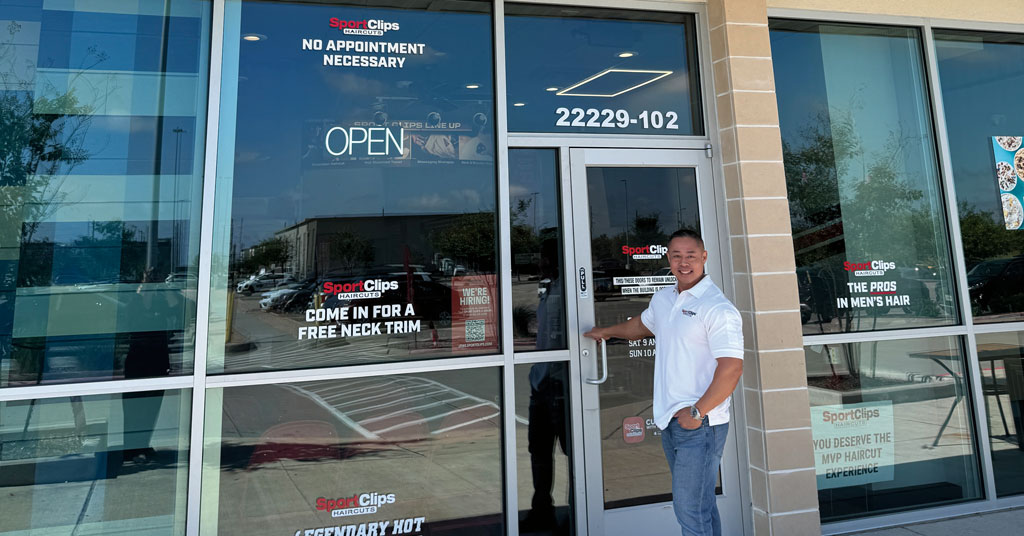
Over the past two decades, Cheston Syma has applied hard-won lessons from the Marines, a failed business, and dangerous overseas assignments to build a growing multi-brand franchise portfolio.
Syma joined the U.S. Marines out of high school and served for six years on active duty. After leaving the military, he earned a degree in business finance from the University of Houston. He opened a tanning salon in his 20s, but he realizes now that he wasn’t prepared to be a first-time owner.
Seeking out the structure and support of franchising, he purchased two Sport Clips locations in Katy, Texas, in 2004. But the payments for those two units and the tanning salon’s losses put him in considerable debt. He fell back on his military ties and took high-threat protection positions with the State Department and CIA. For five years, Syma pulled the long-distance double duty of running his franchises while providing protection for U.S. officials traveling to and from embassies in Iraq and Afghanistan. Syma used his Internet access to manage administrative tasks and stay in constant contact with the managers running his two Sport Clips locations back home.
“When you are put between a rock and a hard place, you don’t have much of a choice,” Syma says. “That was my only out. I couldn’t find a job locally that would pay me as much as they were paying me. It was a very dangerous job. In my mind, I was thinking I’m going to take my military experience, get paid a lot of money, and if I live, I’ll be set.”
The money he made while working overseas allowed him to pay off the loans of his two stores and slowly add a few more units. Syma said once he got to five locations, he faced a fork in the road. He could sell and pursue something else or go all in with Sport Clips. He chose the latter, and his plan for scaling the business took off.
Syma partnered with Dr. Setul Patel in 2018 to fuel growth. Soon afterward, a franchisee in Dallas offered to sell 18 salons, tripling the size of the business. He has developed long-term relationships with older franchisees in the Sport Clips system, and several of them have sold their stores to him when they were ready to retire. He said that about 70% of his stores have come through acquisitions.
He is now up to 43 Sport Clips locations and has branched out to several other brands in recent years. Having long been attracted to “Amazon-proof” and, more recently, “AI-proof” businesses, Syma signed agreements for 10 Big Blue Swim Schools in Houston, 12 SweatHouz locations in Austin, and one Hand & Stone Massage & Facial Spa in Magnolia, Texas. One of his next goals is to hire people to oversee the daily operations of each brand to give him the freedom to travel more and enjoy what he has built over the past two decades.
“I don’t see myself leaving what I currently have, but I don’t see myself adding more brands,” Syma says. “I am at the point in my career and personal life in which I want to try not to work so much and enjoy what I have done. I would like to take my success and enjoy the fruits of my labor and slow down a bit.”
PERSONAL
First job: Worked on a farm in rural Texas when I was 12.
Formative influences/events: I came from very humble beginnings, which taught me the importance of hard work. I served in the Marines, which taught me what good and bad leaders look like. I learned how to persevere and carry on with grit.
Key accomplishments: My very successful tenure in the Marines and employing more than 400 team members across all my businesses.
Biggest current challenge: Identifying, hiring, and retaining talented employees. In the hourly rate pool of talent, it is more difficult to find good leaders and people with business experience. The people who have that often go off and do the right thing. When you do find them, you have to compensate them well and take care of them.
Next big goal: Promoting the top leaders in the company to take on larger roles.
First turning point in your career: Buying my first two Sport Clips paved the road to where I am today. Because the first two units were successful, it allowed me to expand to many other locations.
Best business decision: Joining Sport Clips in June 2004. The franchise has many great values that I share as well.
Hardest lesson learned: Losses will come, and some will take a heavy toll mentally, psychologically, and financially, but you can never give up. If you do, you lose. My first business was owning a tanning salon when I was 24. I was just out of college and didn’t have much money. I ended up losing more than $400,000 over a 10-year period. That was pretty painful. What if I gave up my entrepreneurial journey and took a job? I’m sure I would be happy, but I wouldn’t be where I am today.
Work week: I am always on call, checking emails and responding even on weekends or while on vacation. Most of my work I can do on the go from my phone. I am the last resort for all my employees, and they know I can be reached any time, any day, if the rest of the leadership team cannot be reached.
Exercise/workout: Morning cardio at 7:30 a.m. for 40 minutes followed by afternoon weight training for 60 minutes. I do both five times a week and play in an adult soccer league on Sundays.
Best advice you ever got: My father told me that opportunities are everywhere; you just need to have the ability to find them and execute on them.
What’s your passion in business? Developing leaders and watching their rise in life and in work and helping them accomplish their personal and family goals.
How do you balance life and work? By having a great team behind me to handle the day-to-day challenges. People often ask how I manage 50-plus businesses, and I tell them it’s easier than managing 10 because now I can afford to have a very talented team to support me.
Guilty pleasure: A few glasses of a great cabernet during dinner, which I only do once or twice a month.
Favorite book: A Game of Thrones.
Favorite movie: “The Wolf of Wall Street.”
What do most people not know about you? I spent three years working as a security contractor for the CIA in Afghanistan.
Pet peeve: Negativity. Your attitude or perception wires your brain. If you are mostly negative, your brain will be rewired to view the world from a negative viewpoint.
What did you want to be when you grew up? I had always wanted to be an infantry Marine.
Last vacation: A Bahamas cruise in April 2026.
Person you’d most like to have lunch with: My dad, who passed away in 2001. You can never have enough time with those whom you truly love.
MANAGEMENT
Business philosophy: I will quote Marcus Lemonis on this: “People, products, and processes.” Find and hire the right people and treat them right. Have a great product. Have processes in place that are replicable, easy to understand and manage, and can stand the test of time.
Management method or style: Train the trainer, trust but verify, and employees will execute the job at hand. Be the cheerleader for your people.
Greatest challenge: Finding good employees who share your values. I think this is the biggest challenge for all businesses.
How do others describe you? Strategic, structured, involved, and fair.
Have you ever been in a mentor-mentee relationship? What did you learn? I have had many great mentors in my life. Most were while I was in the Marines, and I was lucky enough to serve alongside them. I learned everything I know today about leadership, patience, tact, integrity, and unselfishness.
One thing you’re looking to do better: Learn about AI and how to effectively use it in the business to increase efficiency and productivity.
How you give your team room to innovate and experiment: I do not control my district managers’ daily schedules. I let them lead, manage, and work as they deem fit with the desired outcome detailed for them. I am always a phone call or text away, so support is always there, and I am in daily contact with most of them.
How close are you to operations? I am very close to operations, but I do miss being closer. When I did not have as many locations, I knew all my people by name. Now, I only know my district managers and a handful of team members well. It’s the sacrifice of getting big, but I do miss the intimacy of being a smaller operator.
What are the two most important things you rely on from your franchisor? Innovation and brand awareness/reputation.
What you need from vendors: One of the main things I look for from a vendor is responsiveness. As a franchisee, many of my vendors are selected by the franchisor. For the ones I can choose on my own, I want quick responses and good communication.
Have you changed your marketing strategy in response to the economy? How? I have not. I typically am not a fan of continuous discounting, which degrades a brand’s value and perception. A few times a year, I will run large marketing campaigns with discounts, but those are random so that customers do not come to expect or rely on them. Many times, when a business does continuous discounting, it brings in a different type of clientele we may not want, replacing other clients we do want.
How is social media affecting your business? The great thing about franchises is that they usually handle the heavy lifting on social media. We have a part in it, but I leave that to the district managers since I don’t personally have or use social media.
In what ways are you using technology (like AI) to manage your business? My goal for the foreseeable future is to learn how to use AI to manage and increase efficiency in HR management, bookkeeping, forecasting, and financial analysis. AI is moving so fast, and it is truly difficult to learn and keep up with it.
How do you hire and fire? I like to hire based on personality and teach the skill. I seldom like to fire, but when I do, I will give people more than enough chances so that I have a clear conscience. I should probably hire fast and fire faster, but maybe my heart is too big, and I give too many chances.
How do you train and retain? I have a system and a progressive path for training. Retention is not very easy to manage since every employee wants something different in their job or life. It’s not always about paying the most. There are so many variables to get right, and even when you do, people will still leave due to personal reasons. We try our best to provide the best pay we can along with the best culture, training, recognition, support, and clients.
How do you deal with problem employees? Most problem employees want to be heard. If you give them that and reaffirm expectations, many times they can evolve into good employees. For those who cannot evolve, an exit is the last resort.
Fastest way into your doghouse: Having a lack of integrity.
Bottom Line
Annual revenue: $18 million.
Goals over the next year: I want to trim the fat or the inefficient stores from the company. There will be some locations that are not doing as well, and they are dragging down the profitability of the other stores.
Growth meter: How do you measure your growth? Client count is the best way to measure business growth. Sales are a good indicator but can be misleading due to price increases over time. Employee retention is a good way to measure business culture and morale.
Vision meter: Where do you want to be in five years? 10 years? In the next five years, I would like to be able to have a director of operations manage the daily challenges. I cannot see that far out in 10 years. So much can change in that time.
Do you have brands in different segments? Why/why not? I try to stick to something that is Amazon-proof, AI-proof, and service related. Men’s haircare, swim lessons for kids, and health/wellness are the segments I am in that cannot be taken over by technology.
How is the economy in your region(s) affecting you, your employees, your customers? Currently, macroeconomic conditions remain strong enough that they haven’t affected my businesses very much. Sport Clips does better in a recession, but the other brands may suffer. That is why it is good to diversify.
Are you experiencing economic growth in your market? It varies by location.
How do changes in the economy affect the way you do business? Being diversified allows me to be positively affected in both good and bad economies. One business may fare better in a recession while others flourish in a growth cycle.
How do you forecast for your business? I forecast more competition coming into each market and a compression of profits. Most businesses stabilize around a 15% profit margin once the market reaches maturity. If I see a 25% margin, I don’t expect that to last forever. If the margins are good, competition will enter and take market share. At a 15% profit margin, the name of the game would then be volume.
What are the best sources for capital expansion? Good relationships with more than one bank.
Experience with private equity, local banks, national banks, other institutions? Why/why not? I do not have experience with private equity, but I do with local and national banks. I tend to like local banks better because smaller banks can make decisions faster, and a better banking relationship can be formed with top decision-makers.
What are you doing to take care of your employees? Above market pay, constant recognition, having an open-door policy, adequate training, good benefits, and providing them with good leaders to follow.
How are you handling rising employee costs (payroll, minimum wage, healthcare, etc.)? Unfortunately, the price is rising on everything and not just wages. With inflation, wages must go up; thus, prices must increase, but they can only go up so much. Profit margins tend to compress with rising costs, so a balance is met somewhere between rising prices and lower margins, especially in times of high inflation.
What laws and regulations are affecting your business, and how are you dealing with them? Most of the laws and regulations affecting my businesses have to do with professional cosmetology and barber licenses. Currently, there are many states that require 1,500 credit hours to get a cosmetology or barber license while some states require only 1,000 hours. The extra 500 hours may push students away from this industry due to cost and time.
How do you reward/recognize top-performing employees? My pay plan is structured so that the top-performing employees are automatically recognized with bonuses. The entire leadership team gives constant praise and recognition. Sport Clips also has a great infrastructure to recognize tenure and top performers at the individual and store level, and recognition is given at the national convention.
What kind of exit strategy do you have in place? Currently, I am content with my work-life balance and do not see a need to exit. I know at some point that sad day will come, but at this time, I am more focused on growth and performance.
Share this Feature


Recommended Reading:


Franchising.com is produced by Franchise Update Media. Franchise Update Media has its finger on the pulse of franchising with unrivalled audience intelligence and market driven data. No media company understands the franchise landscape deeper than Franchise Update Media.
1201 New York Avenue NW, Suite 300A
Washington, DC 20005
PH. (408) 402-5681
 The multi-unit franchise opportunities listed above are not related to or endorsed by Multi-Unit Franchisee or Franchise Update Media Group. We are not engaged in, supporting, or endorsing any specific franchise, business opportunity, company or individual. No statement in this site is to be construed as a recommendation. We encourage prospective franchise buyers to perform extensive due diligence when considering a franchise opportunity.
Copyright © 2001 - 2026. All Rights Reserved. Legal Notices | Privacy Policy


